
The AI Project Worked. Then The Team Stopped Using It.
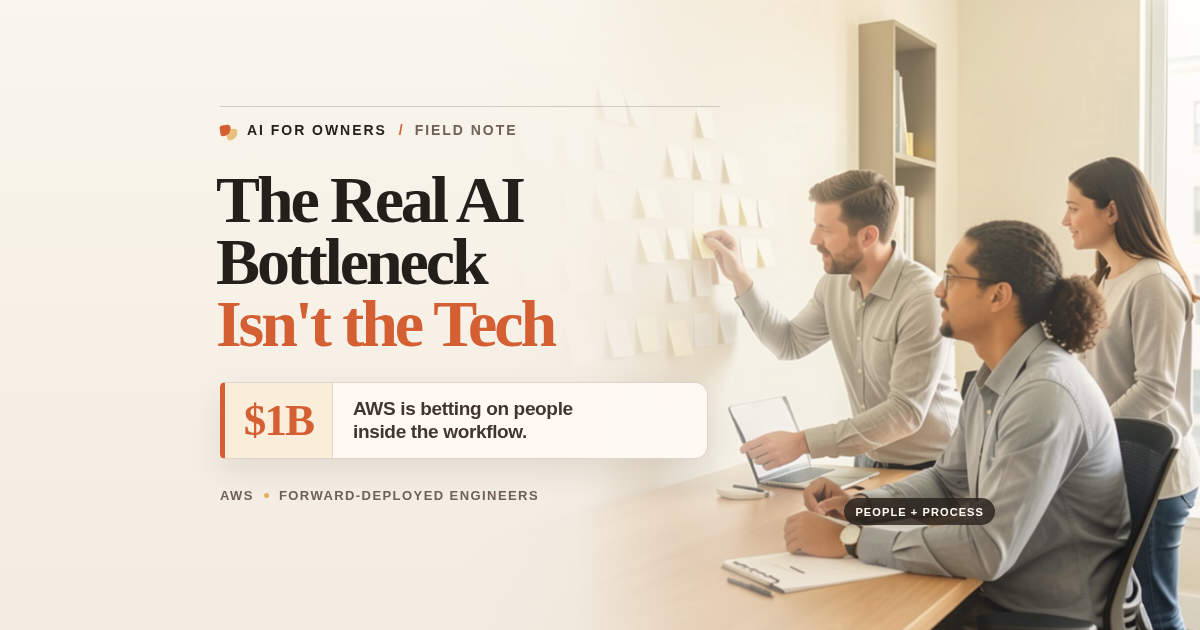
There is an important lesson echoing through businesses big and small. You can build an AI workflow that works as designed and still waste every dollar spent on it.
No matter the business size the same issue is recurring: the person who owns the process was not involved early enough. The new workflow misses how the job is really done, or arrives without clear expectations. Within weeks, the team returns to the old method.
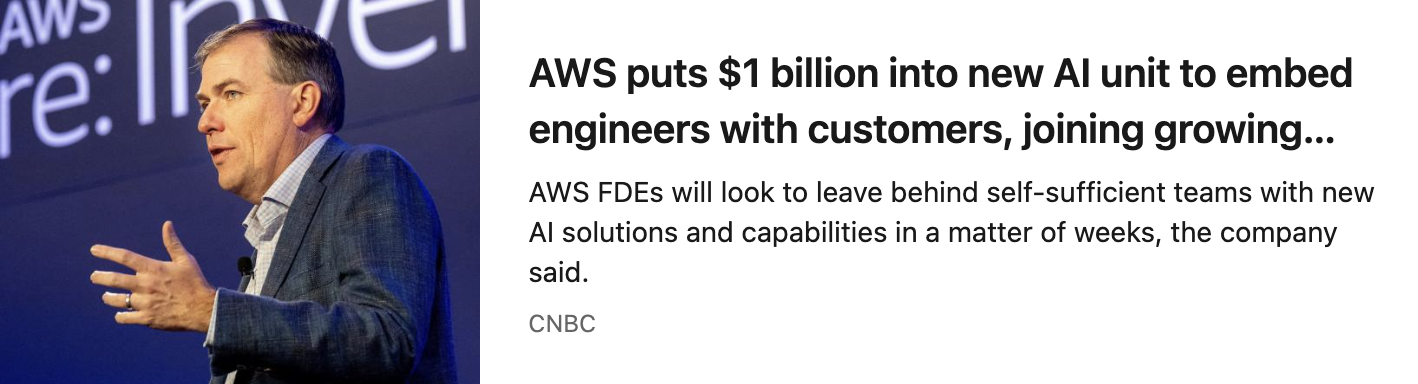
AWS just committed $1 billion to embed thousands of engineers inside customer companies to work on AI projects. That is a striking admission: buying AI is easy. Getting a new workflow to survive contact with the people who must use it is the hard part.
What does this mean for the SMB owner? Keep reading to find out.
What you'll learn from this article:
- The real reason enterprise AI deployments succeed or fail (it's not the technology)
- The lesson enterprises are paying $1B to fix (that you can learn from)
- A four-question framework to find your first AI process
The $1B bottleneck
Everyone can buy the same intelligence now. Access to AI is no longer an edge (or a guarantee of success). Deployment is.
When I read between the lines of the Amazon article I see that the engineers are not there just to write code. They are there for change management.
I have more than 20 years of experience in IT consulting. Change Management is the unspoken key to success. I've seen a new desktop icon rolled out to thousands of users Desktops on a Saturday cause a flood of helpdesk calls on Monday morning. Something as simple as changing a Desktop icon requires clear communication and expectation setting. Imagine what a new AI powered workflow requires.
Here is what the big firms learned. Within months the workflow reverts because nobody on the inside owns it. There wasn't sufficient change management for the systems to take root with the internal teams.
That is not an engineering or AI problem. It is a people and process problem wearing an engineering budget.
An AI deployment is not a set of tools. It's a mapped process, with every touchpoint understood, that solves a real problem at low risk.
That is why SMBs need to treat AI as operating infrastructure, not tool experimentation.
Where to start if you are not an enterprise customer
You do not need an embedded engineering team to begin.
Pick one painful process. Inbound lead handling. Proposal drafting. Customer follow-up. Weekly reporting. SOP lookup. Job scheduling.
Then answer four questions:
- What happens today?
- Where does the process break or slow down?
- What information does the AI need to help?
- What should a human approve, check, or decide?
If a process can be measured objectively it's a candidate for early automation.
That is where AI stops being personal productivity and starts being company capability.
A few employees using ChatGPT can save time. That is fine. But it does not change how the business runs. AI adoption becomes real when it is attached to a repeatable process, uses the company's context, fits the team's habits, and produces a measurable result.
Do not start by asking: "What AI tools should we buy?"
Start by asking: "Which process would make this business more competitive if it ran 30% faster, with fewer missed handoffs?"
That is the process to test first.
Not sure which process to test first? DM me “process.” I’ll help you identify one practical starting point with a clear result you can measure.
Sources: CNBC, June 30 2026 · Nadella, Davos interview · "Forward Deployed Engineers" with Voss, Veric Agents