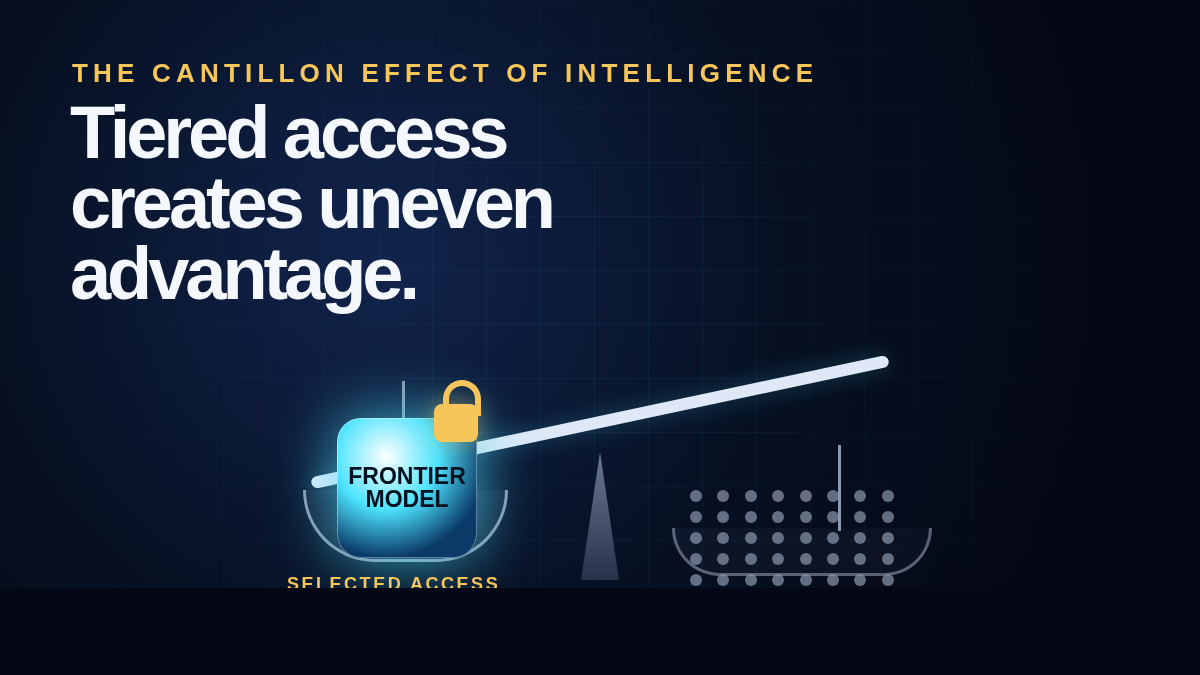
The Cantillon Effect of Intelligence
There is a new and troubling trend for AI in the USA. Tiered intelligence. A digital caste system.
Recent reports state OpenAI is limiting early access to its newest model, GPT-5.6, to a small group of trusted partners before broader public release. Anthropic has taken a similar path with powerful models shared first with select companies and safety reviewers. The stated reason is safety and regulatory pressure, especially around cybersecurity, misuse, and national security.
This changes the economics of AI.
If the best models reach only a handful of companies first, those companies get more than early product access. They get early access to a higher grade of intelligence.
That creates a familiar economic pattern.
Economists call it the Cantillon effect.
The Cantillon effect describes what happens when new money enters the economy unevenly. The people closest to the source of new money benefit first. Banks, asset holders, government contractors, and politically connected firms can buy, invest, and reposition before prices adjust. By the time the money reaches everyone else, the early advantage has already been captured.
AI may now be developing its own version of this.
Call it the Cantillon effect of intelligence.
The companies closest to frontier model access can build faster, automate deeper, write better software, improve internal workflows, and widen their lead before the rest of the market touches the same capability. In software, a few weeks can be enough to ship features, close customers, or raise capital. In AI, where the tool itself accelerates production, that delay compounds.
This is not just a release schedule. It is market structure.
At the top are frontier labs, major partners, government-approved firms, and incumbents with the compliance capacity to qualify. Below them are startups, independent builders, researchers, small firms, and the broader public waiting for delayed access.
That is the same shape as the original Cantillon effect.
Money created near power becomes asset advantage.
Intelligence released near power becomes execution advantage.
Rules for thee, but not for me.
There is no simple answer. It's truly a quandry of how to balance AI capabilities with safety complicated by the fact that foreign based open source models are competitive as the highest levels with near zero oversight.
This genie can't be put back in the bottle. What do you think? Should the USA limit access to the latest models and bear the consequences?