
The Four Levels of AI Agency
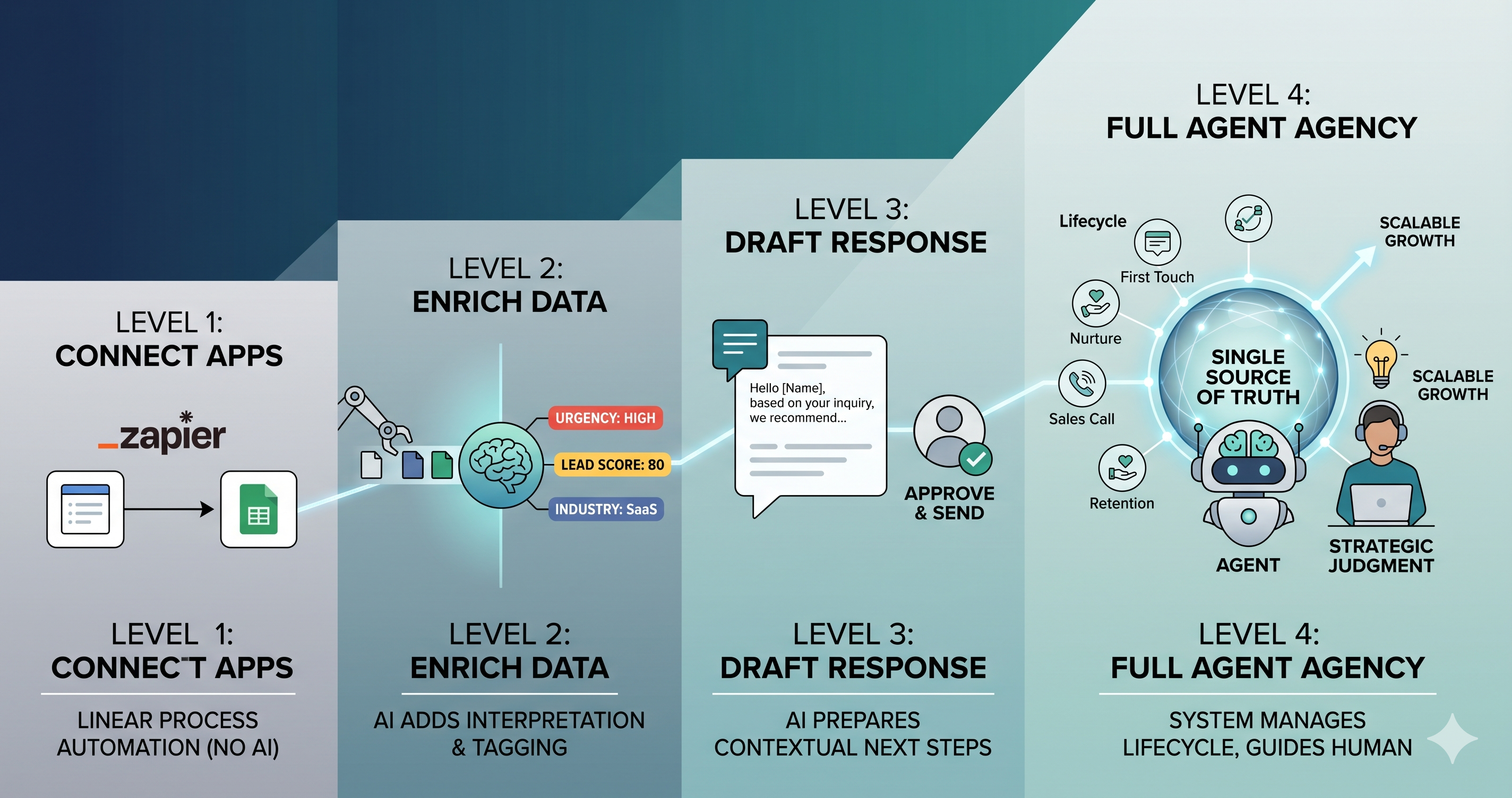
What level is your business at?
The odds are that you are here:
You are talking about prompts. You are talking about chat windows. You are talking about a few clever automations stitched together with Zapier.
It's a good start. But in today's world it's the bare minimum.
If you want an honest way to assess your competitive position, it helps to look at four levels of AI agency.
Level 1: Connect two apps using Zapier
This is the entry level. Most businesses are here.
A form gets submitted. Zapier sends the data somewhere else. Maybe into a CRM. Maybe into Slack. Maybe into a Google Sheet.
Useful? Yes.
Intelligent? Not really.
This is brainless automation. A straight line from trigger to action.
If X happens, do Y.
There is nothing wrong with that. In fact, a lot of businesses should start here because many manual tasks do not need AI. They just need to stop being done by hand.
But we should call it what it is: linear process automation.
Level 1 reduces clicks. It does not improve judgment. It moves information. It does not understand it. It saves admin time. It does not change how the business thinks.
That matters, because too many teams label this as “AI transformation” when it is really just plumbing.
Level 2: Add AI to enrich the data before it lands
Now the workflow starts to get more useful.
The trigger still happens. The automation still routes data from point A to point B. But now AI does something to the data on the way.
It might:
- classify the lead
- summarize the inquiry
- extract pain points from free text
- guess intent
- tag the account by industry or use case
- score urgency or fit
This is where automation stops being pure transport and starts adding interpretation.
Instead of just pushing a form into the CRM, the system can say:
This looks like a services business. They probably have a founder bottleneck. Their issue is not “AI adoption.” It is fragmented handoffs and undocumented workflows.
That is a better endpoint than a pile of raw fields.
Level 2 is where AI starts earning its keep.
But it is still limited. The system is helping organize information, not act on it in a meaningful, customized way.
You have more intelligence in the pipe, but the business still relies on humans to decide what happens next.
Level 3: Draft the right response based on customer data and product fit
This is where most businesses start to feel the difference.
At level 3, the system is not just enriching the data. It is using that enriched data to prepare the next move.
That could mean:
- drafting a follow-up email
- generating a customized sales response
- producing a proposal outline
- recommending the right product or offer
- preparing a support reply based on account history
The key shift is this: the output is now contextual.
The business is no longer sending the same generic follow-up to everyone. It is using customer data, intent, and product match to draft something that feels specific.
That is real leverage.
A lead comes in. The system enriches the record. It identifies likely needs. Then it drafts the response that a human would have written anyway, but faster and with the relevant details already pulled in.
This is where AI starts reducing cognitive load, not just admin load.
And that is an important distinction.
Admin load is moving data around. Cognitive load is figuring out what the data means and how to respond.
Level 3 helps with both.
But it still has a weakness.
In many businesses, the context is scattered across too many apps. The AI can draft a response, but only using whatever slice of information happens to be available in that workflow.
So the response gets smarter, but the system is still fragmented.
Level 4: AI and BI are fused into an orchestration layer
This is the level where most “AI automation” comparisons start to break down.
A good CRM can store records, trigger workflows, and keep a timeline. That is useful. But it is not the same as agency.
At level 4, the business has an intelligence layer sitting on top of its operation. AI is no longer just enriching records or drafting responses. It is working with business intelligence to interpret what is happening across the system, decide what matters, and coordinate the next best action.
That means the system can pull from live operational data, historical patterns, commercial context, and current state at the same time. It can see not just that something happened, but what it likely means and what should happen next.
So instead of simply logging a customer reply or triggering the next email, the system can ask better questions:
- Is this account becoming more valuable or more risky?
- Is this issue isolated or part of a pattern?
- Should we follow up now, change channel, escalate, or hold?
- Does this need a human, or would that just create noise?
That is the real jump.
Level 4 is not “single source of truth” on its own. It is not “all the data lives in one place.” That is necessary, but it is only the foundation.
The real step up is that the system uses shared context to run a decision loop across the business.
A practical example would be a service business where delivery, support, sales, and finance all feed the same intelligence layer. The system notices that a high-value account is drifting off course: response times are slipping, margins are tightening, the same issue has reopened twice, and the customer’s tone has changed. It does not just update the record or draft a polite email. It flags the risk, recommends the intervention, routes it to the right owner, prepares the response, and adjusts downstream priorities.
That is not just automation. That is orchestration.
At this level, humans are not buried in dashboards or copied on every workflow. They get pulled in when judgment is needed, with curated context and a recommended next move.
That is what real AI agency looks like: not better record-keeping, not faster message drafting, but a system that helps run the business with more awareness, better timing, and less noise.
Why this matters
A lot of companies are proud of reaching level 1 and describing it like level 4.
That creates two problems.
First, it makes the business overestimate how advanced it really is.
Second, it leads to bad investment decisions.
If you think the problem is “we need more AI,” you will buy more tools.
If the real problem is that your customer data is fragmented, your process is undocumented, and no system owns the lifecycle, then more tools will just give you more sophisticated chaos.
That is why most AI efforts stall. Not because the models are weak. Because the operating layer underneath them is messy.
Where most businesses really are
Most companies I see are somewhere between levels 1 and 2.
They have a few automations. They may use AI to summarize or tag data. But they still rely heavily on humans to piece together context, decide the next step, and keep the process moving.
A smaller number are reaching level 3 in pockets, usually in sales, support, or lead handling.
Very few are truly at level 4.
Not because level 4 is impossible. Because level 4 requires discipline.
You need:
- a clear system of record
- consistent data structure
- defined lifecycle stages
- rules for when automation acts and when humans step in
- enough trust in the process to let the system carry more of the load
That is less exciting than talking about agents. But it is what makes agents useful.
The practical takeaway
Do not ask, “How do we use AI?”
Ask:
- Are we just moving data?
- Are we enriching it?
- Are we drafting the next best action?
- Or do we have a system that can track the lifecycle and route humans only what matters?
That is a better maturity test.
Because the goal is not to sprinkle AI on top of broken operations. The goal is to build a business where automation handles the predictable work, AI handles interpretation and drafting, and humans step in where judgment truly matters.
That is what agency should mean.
Not more tools. Better operations.